DRISHTI · VOLUME 001
The Extent of Doubt
The same doubt appears in a forest, a coast, a farm, and a grid: how early can evidence become understanding?
EARTHVISION LAB · ~12 MIN READ
BEFORE THE EVENT
Before the evidence appears
Judea Pearl's ladder of causation stays in my head because it gives language to a discomfort I keep meeting in Earth observation. Association asks what tends to appear with what. Intervention asks what would happen if something changed. Counterfactual reasoning asks what would have happened if the world had turned slightly differently.
Most observing systems are very good once the world begins to confess. A thermal anomaly appears; an active fire is likely. Water spreads across ground that was dry yesterday; flooding has probably begun. Vegetation changes; stress may be present. These are not trivial achievements. They save time, money, and sometimes lives.
But the question that keeps bothering me usually arrives before the visible evidence. Which dry forest is about to burn? Which basin is becoming dangerous before the water crosses the road? Which crop is entering failure while it still looks healthy from a distance?
A wildfire makes the distinction uncomfortable. Seeing heat after ignition and recognising a landscape becoming dangerous before ignition are not the same problem. The first asks whether an event has started. The second asks whether several ordinary conditions are converging toward something rare.
A tsunami exposes the same gap from another direction. The earthquake may be detected before the water reaches a distant coast. But the decision that matters is local: where will the water become destructive, how far inland will it travel, and which places have minutes rather than hours? Detecting the cause is not yet understanding the consequence.
A three-hour warning and a three-day warning can look like versions of the same product, but they are not the same thought. One begins after the world has started confessing. The other asks whether the conditions for an event can be recognised before the proof arrives.
A sensor can tell me something changed. The harder question is whether it can tell me what kind of future that change belongs to.
LIVING SYSTEMS
While the system still looks healthy
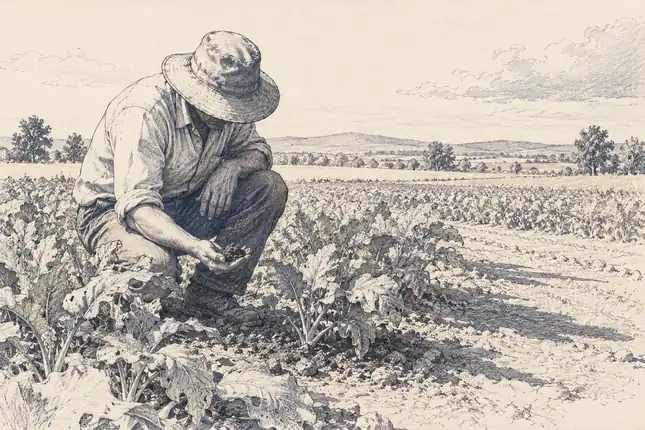
Agriculture is where this becomes personal for me. A farmer does not need a satellite to know the sky has been strange. The body learns seasons. Soil has a smell before rain. Leaves carry small warnings. People who work with land often trust signals that would look unscientific until an instrument rediscovers them under another name.
A crop can remain green while already under stress. A forest canopy can still look intact while heat, drought, disease, or competition are changing what happens inside it. The visible state and the future state do not have to fail at the same time.
That is the uncomfortable part of monitoring living systems. By the time a field is visibly failing, part of the useful decision window may already be gone. The question is not only whether stress can be measured. It is whether the signal arrives early enough, and with enough context, to change what somebody does next.
Wildlife creates another version of the same doubt. Cameras and recorders can collect more evidence than a person could ever review unaided. A species can be detected, counted, heard, and followed. None of those observations, by themselves, explain why a population is falling or whether a habitat is approaching a threshold from which it will not easily recover.
There is an old farming proverb: the best fertilizer is the farmer's shadow. I used to read that as nostalgia. Now I read it as a warning about proximity. The view from above and the view from the ground are not rivals. They know different things.
A field can be machine-readable and still not be understood.
BUILT SYSTEMS
Measurement is not the decision
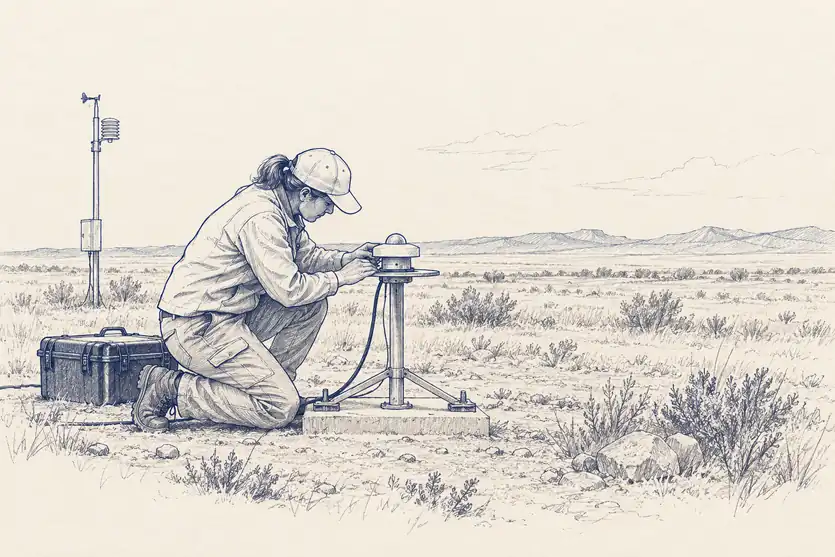
The same pattern appears in infrastructure. A solar developer can look at years of satellite-derived irradiance before anyone has placed an instrument on the site. That is extraordinary. It turns an unknown field into a candidate before a team ever travels there.
Then the ground station arrives anyway. The modeled sunlight has to be adapted to the site before money, insurance, and engineering decisions become comfortable. I find that sequence revealing. The satellite did not remove uncertainty. It made uncertainty cheaper to approach.
Construction monitoring works in a similar way. Repeat imagery can show whether earthworks advanced, whether a roadbed moved, whether a transmission corridor cleared, or whether a dam project changed shape between visits. The visible world becomes an audit trail.
But a bridge can look complete before it is trustworthy. A grid can look mapped before it is resilient. A reservoir can look full without telling us whether the next operating decision is safe. Measurement narrows uncertainty, but the decision still depends on relationships the measurement may not contain.
This is where the distinction matters most. A measurement can be correct and still be insufficient for the decision placed on top of it. The failure is not necessarily in the sensor. Sometimes the claim simply asks the evidence to carry more than it can hold.
The measurement can be right and the decision can still be wrong.
THE EXTENT
How far does the doubt go?
A forest, a coastline, a farm, and an electrical grid are not versions of the same system. They obey different physics, operate on different clocks, and fail for different reasons. Yet the same gap keeps appearing between what can be observed and what someone actually needs to know.
History makes the gap wider. The same place under the same weather can behave differently because it arrived there through a different past. Soil stores earlier rain. Forests carry earlier drought. Rivers inherit what happened upstream. Infrastructure carries decisions made years before the event that finally exposes them.
Scale makes it wider again. A planetary measurement can be scientifically useful and still be too coarse for one field, one road, one reef, or one neighbourhood. A local observation can be precise and still say almost nothing about the larger system surrounding it.
And time changes the question completely. Detecting something after it becomes visible, recognising that it is changing, estimating what happens next, and understanding why it is happening are four different claims. We often place them beside one another on the same dashboard as if they were simply better versions of the same answer.
The doubt is therefore not whether observation works. It plainly does. The doubt is how far observation can be carried before context, history, mechanism, uncertainty, and possible futures have to enter the picture.
Before that question can go any further, there is a more basic one: how did we learn to watch so much of Earth in the first place?