DRISHTI · CHAPTER 2
The Decades of Observation
How the world learned to watch Earth, from a tube of mercury to a sky full of satellites and a continent of birdwatchers.
EARTHVISION LAB · ~6 ARTICLES
WHY WE STARTED WATCHING
People did not start watching the planet out of curiosity. They started because they were afraid of it.
On the night of 25 October 1859, a storm with gusts near 100 miles per hour tore across the Irish Sea and sank or wrecked more than 200 ships, among them the Royal Charter, which went down off Anglesey with more than 450 people aboard. Robert FitzRoy, formerly captain of HMS Beagle and by then head of Britain's new meteorological department, went through the weather readings afterwards and found that the storm's approach had been visible in them. It had simply been visible in too many separate places, on too many separate sheets of paper, for anyone to see it coming. Two years later he was telegraphing those readings to London and printing the world's first public forecasts.
A century later the fear came from above. On 4 October 1957 the Soviet Union put Sputnik into orbit, a polished sphere of 83.6 kilograms that did nothing but beep. Americans listened to it with alarm. At the Johns Hopkins Applied Physics Laboratory, two young physicists, William Guier and George Weiffenbach, listened more carefully and noticed the pitch of the beep rising as Sputnik approached and falling as it left, the same Doppler effect that changes the sound of a passing siren. From that warble alone they worked out the satellite's entire orbit. Their director, Frank McClure, then turned the idea inside out: if a satellite's orbit is known, the warble can tell a listener on the ground exactly where they are. That became Transit, the first satellite navigation system. Meanwhile Sputnik's orbit sagged a little each day as thin air dragged on it, and measuring the sag weighed the upper atmosphere. The first satellite carried no instrument for observing Earth, and observed it anyway.
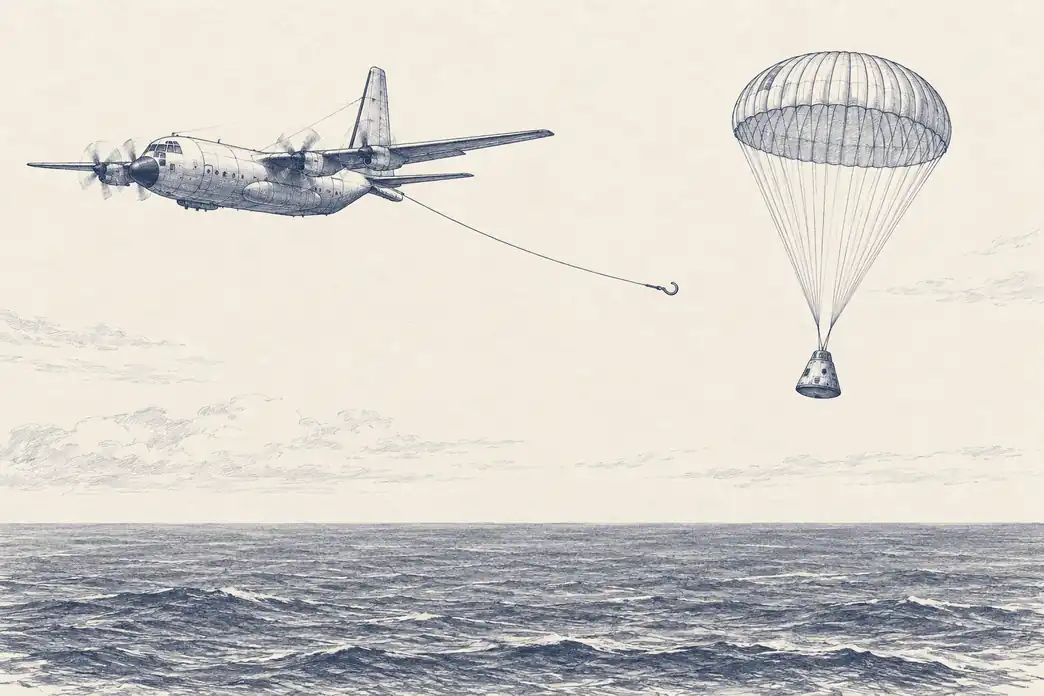
Then came the fear of what the other side was hiding. The United States answered with Corona, a reconnaissance satellite officially described as a research program called Discoverer. It could not transmit pictures, so its film came home in a capsule that fell back through the atmosphere, opened a parachute over the Pacific, and was caught in midair by an Air Force aircraft trailing a hook. This was not a figure of speech. It was the plan. The first twelve attempts failed in a satisfying variety of ways, until in August 1960 an aircraft snagged the capsule from Discoverer 14 with about 20 pounds of film aboard, and a national intelligence program settled into running on the reliability of a hook.
Storms, rockets and missiles: the first great watching systems were built out of fear, and every one of them recorded far more than it was built for. FitzRoy's storm network became the beginning of a climate record. Sputnik's beep became satellite navigation. Corona, aimed at missile silos, could not avoid photographing the wheat fields, rivers and glaciers around them, and when its images were declassified decades later they became one of the earliest pictures of a changing planet. An instrument does not know what its operator intends. That turned out to be the most useful thing about it.
Almost every leap since came from changing where the watcher stood. On the ground, instruments produced precise points with nothing between them. In orbit, cameras produced pictures of whole regions at once, and satellites learned to read light the eye cannot see, heat, radar echoes and even weight. A few programs turned those pictures into records by refusing to stop. Then the watching stopped belonging to governments, as companies filled the sky with cheap satellites and ordinary people with binoculars filled the ground with observations. And all along, other watchers that nobody launched were at work: plankton recorders behind cargo ships, microphones on the seabed, floats that dive on their own, and tags on birds and seals.
CHAPTER CONTENTS
PART I
Where the watcher stood
Mercury, Rain and a Starling Called VIBORG 1
For three centuries, watching Earth meant standing on it. The instruments were brilliant. The view was a scatter of dots.
The First Picture of Earth Fell Out of the Sky
A camera on a captured rocket, a spy program caught by a hook, and a geologist who wanted everyone to see.
PART II
What the planet gives away
PART III
Watching without stopping, and watching together
The Missions That Changed How We See Earth Forever
Landsat refused to stop, Copernicus gave a whole planet's worth of instruments away, and MODIS made every day the normal interval between looks.
Everyone Is Watching Now
Launch got cheap enough to lose satellites on purpose, and a hobby got organised enough to count a continent's birds.
The Watchers Nobody Launched
A box towed behind cargo ships since 1931, submarine microphones that heard whales, radars that see birds, and seals recruited as oceanographers.