DRISHTI · CHAPTER 4.6
Can the Whole Planet Share One State?
Not one model of Earth, but many systems that know how sure they are, say where their numbers came from, and refer to the same changing world.
EARTHVISION LAB · ~20 MIN READ
ONE CHANGING WORLD
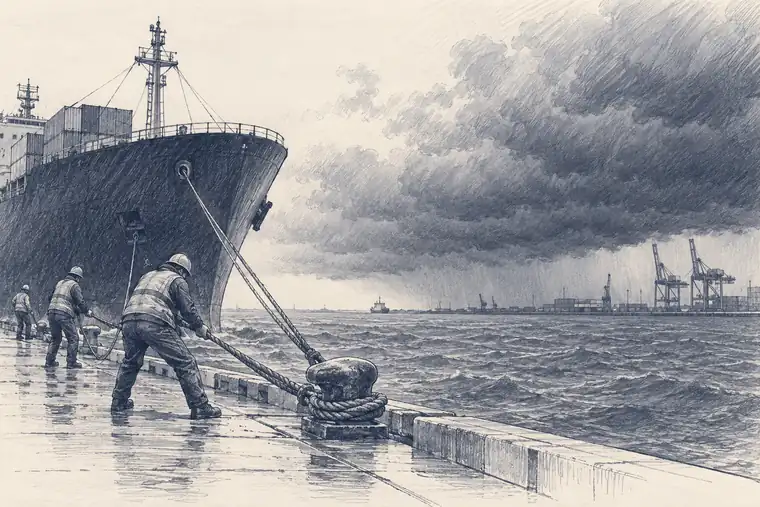
At 07:00 UTC a cyclone forecast changes the expected inflow to a reservoir. The reservoir changes flood risk downstream and hydropower output. Cloud changes solar generation. Wind changes both the storm track and the grid forecast. A port considers closing. Ships alter course.
Fields downstream have three weeks left before harvest. Every one of these systems has a model. None of the models owns the whole consequence.
Volume 3 explained why one enormous model containing atmosphere, rivers, grids, crops, ships and institutions becomes impractical very quickly. The objective here is weaker and more useful: let specialised systems maintain compatible beliefs about the same changing world. The cyclone can stay a probability field, the reservoir a time series, the grid a network, the ship a moving object with a route, the field a parcel with a crop in it.
Compatible beliefs need two things that individual models are bad at supplying. Each system must know how far its own answer can be trusted, and each must be able to point at the same reservoir, the same hour and the same source as everyone else. Doubt and reference turn out to be the hardest parts of intelligence to engineer.
CALIBRATION AND KINDS OF DOUBT
A probability is not automatically trustworthy
Neural networks are very good at producing probabilities, which is not the same as being good at knowing how uncertain they are. A classifier can say 97% in impressive typography and be wrong far more than 3% of the time. Calibration asks whether confidence matches frequency: among many predictions made at about 80% confidence, about 80% should be right. Guo and colleagues showed in 2017 that modern networks can be systematically miscalibrated even when accurate, and that a simple correction called temperature scaling often fixes much of it without changing which class wins. The probability layer has its own way of failing, and a better classifier does not automatically repair it.
Doubt also comes in two kinds. Aleatoric uncertainty lives in the observation: cloud hides the ground, a boundary cuts through a pixel, rainfall varies within a few hundred metres. Even a perfect model cannot recover what the measurement never contained. Epistemic uncertainty lives in the model: it has seen few examples of this landscape, sensor or event, and better or more representative evidence could reduce it. The right response differs. A hidden surface needs another sensor or a later pass. An unfamiliar landscape needs a new label or a specialist model. Two predictions at 60% can call for completely different actions, which is exactly what a single confidence score hides.
There are several ways to estimate doubt and none of them is a doubt meter. Deep ensembles train several networks independently and read their disagreement as model uncertainty, a simple approach Lakshminarayanan and colleagues showed works remarkably well. Bayesian approximations such as Monte Carlo dropout run many slightly randomised passes. Conformal prediction wraps an existing model with sets or intervals that achieve a target coverage under stated conditions, so a 90% conformal set contains the true answer about 90% of the time. The model does not become more correct. Its output becomes more honest about the range of answers still plausible.
Every method has conditions, and the planet breaks them for a living. Ensembles can agree because all their members share the same biased training data. Conformal guarantees weaken when deployment drifts away from the calibration data. Fine-tuning a foundation model on a small local dataset can improve accuracy while quietly damaging its uncertainty. Even ECMWF's AI ensemble has documented cases of spreading too widely for some upper-air variables and showing biases in rain, cloud and high-altitude surface temperature. An ensemble is a mechanism for expressing uncertainty, not proof that the uncertainty expressed is correct. Calibration therefore has to be checked by region, season, event type, sensor condition and lead time. Doubt, like almost everything else in this book, has a map.
IDENTITY, TIME, PROVENANCE
Shared state is made of claims, not one giant table
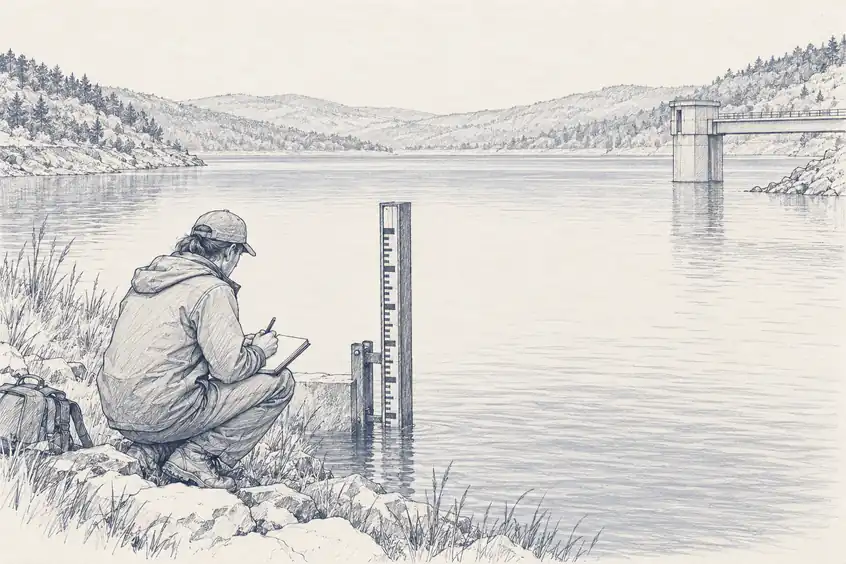
A useful shared state is a set of claims about things and places. Reservoir X stood at this level at 06:50 UTC, measured by gauge Y. Forecast Z expects this distribution of inflow over the next twelve hours. Power line Q is available now but exposed to wind above a stated threshold. Each claim needs an object, a time, a source, a validity window and, after everything above, an honest measure of doubt.
Identity lets two systems know they are talking about the same thing. A river model uses a reach number, an asset register a dam number, a land registry a parcel number and a shipping system a vessel number. They do not need one universal numbering scheme. They need resolvable links, so that the reservoir downstream of this catchment is known to be the same reservoir the grid model calls plant R14. Time needs the same discipline. A value without a timestamp is nearly useless, and a timestamp without a validity interval can be worse: yesterday's soil reading may still be relevant, while yesterday's thunderstorm observation is archaeology.
Provenance stops estimates masquerading as measurements. Two identical numbers may come from a gauge five minutes ago and from a model started six hours earlier. Shared state has to carry enough lineage to tell observed, derived, forecast and generated values apart, or a reasoning system receives certainty without knowing who supplied it. This is where uncertainty is most often lost. A flood model outputs a distribution, an integration layer converts it into a yes-or-no flag, and the next system cannot reconstruct what was thrown away. The doubt has been laundered into certainty by a software interface rather than by evidence.
There are working precedents for this unglamorous plumbing. The OGC SensorThings API standard gives different sensor systems a common grammar of Things, Locations, Sensors, Observed Properties, Datastreams, Observations and Features of Interest, and separates sensing from tasking, so observations and requests back to devices can live in one interoperable system. At far larger scale, WMO's Information System 2.0 became operational on 1 January 2025: national nodes publish notifications of new weather data, Global Brokers pass them on, Global Discovery Catalogues describe what exists and Global Caches serve the core data, with MQTT carrying the alerts and HTTP the data. WIS2 does not claim to be planetary intelligence. It shows that global infrastructure can stay federated and still exchange data promptly, which suggests that the first requirement for shared intelligence is less exotic than a universal model: everyone has to stop inventing a private way of saying new data has arrived.
ORCHESTRATION
The reasoning layer has to know which system to ask
Once state can be addressed across systems, a reasoning layer does not have to contain every model. It can route questions: flooding to hydrology, generation to a grid model, a crop to an agricultural model. The reasoning lies in deciding which tools are relevant and how one answer changes what should be asked next. A cyclone forecast implies reservoir inflow; the inflow changes flood risk and hydro output; grid stress changes what a port closure or heatwave will cost. No single model predicts the whole chain. The orchestration layer notices that one domain's output changes another domain's state.
Contradictions matter as much as implications. A satellite flood map may disagree with a hydrological forecast, a field probe may say wet where the land model says dry, a vessel may appear on radar after its broadcast track ends. The right response is not always to average. It may be to keep the disagreement and ask which evidence is stale, biased or measuring a different part of the world. Routing only confident point values through a chain makes the whole system look more certain at every step; routing distributions, assumptions and validity windows lets each component judge what it received.
Uncertainty becomes operational when the system is allowed to act on it. A classifier can abstain rather than force a label. A forecast can widen its interval. A fusion system can request another sensor, and an autonomous spacecraft can spend its next look on the place where evidence is weakest. Abstaining more often makes the remaining answers more reliable, but a system that refuses every hard case is useless, so the threshold should follow the consequence: a map preview and an alert that closes a port should not need the same confidence.
A planetary intelligence therefore needs to know what it believes, how strongly, why the belief has that strength, and which observation would change it most efficiently. Only then can the loop from prediction back to observation run without confidence becoming self-fulfilling.
Knowing what to observe next begins with knowing which part of the current answer deserves the least trust.
PLANETARY INTELLIGENCE
The machine is a loop, not a model
The architecture that emerges is a loop. Observations update the state. Specialised models push parts of it into possible futures. A reasoning layer notices implications, conflicts and missing evidence. Uncertainty decides whether the system can act on what it knows or should ask for another observation. New evidence returns to the state, and the loop begins again.
No component has to understand the whole planet. A weather model can remain a weather model and a satellite can remain an instrument. Intelligence appears in the coordination: knowing which model is relevant, how outputs relate, when an answer has expired, where the evidence conflicts and what observation would shrink the doubt most. The system never reaches a final state, either. Earth keeps moving while computation runs, a decision changes the system being forecast, and a retasked sensor changes which evidence will exist tomorrow. The target is not a perfect copy frozen at one instant. It is synchronisation good enough to stay useful while the world refuses to stop.
That is a less theatrical destination than a digital brain for Earth, and a more demanding one. A brain suggests one model with one internal view. A planetary intelligence is more likely to be a federation of instruments, databases, physical models, learned models and decision systems, continuously negotiating what the current state means and what should happen next.
The achievement would not be that Earth finally fits inside a computer. It would be that our systems can notice a consequential change, connect it to the parts of the planet it affects, admit when the evidence is thin, and turn that admission into the next useful observation. Earth can continue declining to provide a final schema.
A planetary intelligence is not a model that contains Earth. It is a system that stays in useful conversation with a changing Earth.