DRISHTI · CHAPTER 3.7
Humans Change the Model While It Is Running
Dams, irrigation and policy rewrite the system a forecast thought it knew, while grids, aircraft and ships run forecasts of their own on top of the planet's.
EARTHVISION LAB · ~14 MIN READ
STRUCTURAL CHANGE
A weather model can assume that gravity will still be working tomorrow. A river model cannot assume the river will be operated tomorrow the way it was yesterday.
Build a dam, pave a floodplain, expand irrigation or close a border, and the laws of physics remain entirely intact while the relationship the forecast relied on quietly changes.
This is a different failure from chaos. The present may be known perfectly and the equations may be correct, and the model can still fail, because the system it was calibrated on has been edited by people since.
People also run forecasts of their own. Power engineers, airlines, shipping lines and supply-chain planners developed their own traditions of prediction, with their own vocabulary, for what is recognisably the same problem: estimate the state now, then push it forward under constraints. For most of the twentieth century they could treat the weather as somebody else's department. That arrangement has been getting harder to sustain.
DAMS, IRRIGATION, CITIES
Infrastructure turns outcomes into operations
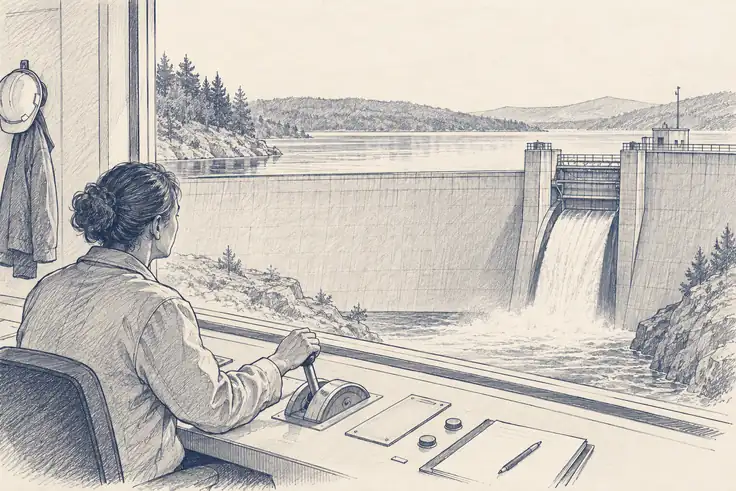
A reservoir converts the flow downstream from a mostly hydrological outcome into a partly operational one. Rain and snowmelt still matter, but so do release rules, power demand, irrigation commitments and decisions about how much space to keep empty for floods. A forecast that knows the catchment and not the operating policy is missing one of its control knobs.
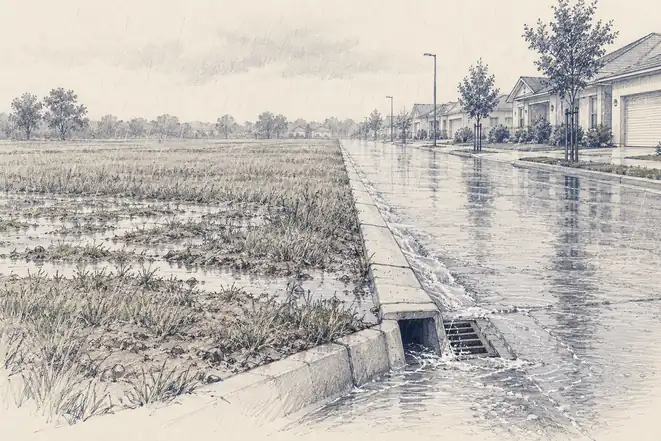
Irrigation alters the system more quietly. Pumping groundwater onto fields changes soil moisture and evaporation, and sometimes the local weather. Cities change how fast rain reaches a river. The land surface is not just being observed. It is being redesigned while the model is still using yesterday's statistics.
Operational models therefore need updates that have nothing to do with meteorology: reservoir schedules, land-cover change, water withdrawals, network changes and management rules. Some of the most important inputs to a modern forecast arrive as spreadsheets, because institutions change faster than physical parameters do.
CONDITIONAL FUTURES
When the future depends on a choice, forecast a scenario
Climate projections handle this openly. Future emissions, land use and economic development are not outputs of atmospheric physics, so modellers run scenarios instead. The Shared Socioeconomic Pathways describe alternative trajectories of population, technology, land use and emissions, and the physical models then calculate the climate that would follow from each.
The word conditional is doing important work. A projection under one pathway is not a claim that the pathway will happen. It says what the physical system would do if that human trajectory did. Mistaking a scenario for a forecast turns a transparent assumption into a false prediction, which is a popular hobby in public debate.
War, regulation, subsidies, trade restrictions and emergency responses can change land use, movement, demand and supply faster than many environmental forecasts run. They are not hidden physical processes waiting for a better sensor. They are choices. Models can estimate the consequence of a decision far more reliably than they can predict the decision: if a port closes, freight can be rerouted; if a dam releases a given volume, the flow downstream can be simulated. Prediction is at its most honest when it knows which of its variables are governed by physics and which by somebody who may change their mind on Tuesday.
ENERGY
The grid has to forecast both sides of the balance
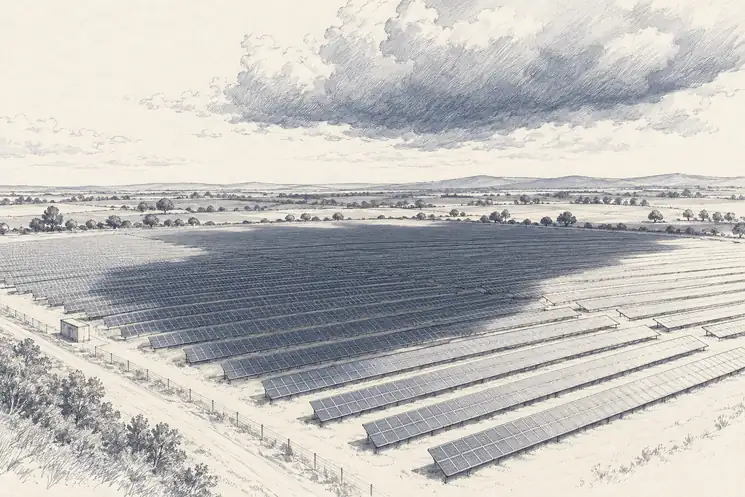
An electricity system has to keep generation and consumption in balance every second. Operators forecast demand from temperature, the calendar and human habit, and increasingly forecast supply from the weather too. Solar output follows sunlight and cloud. Wind turbines follow a steep, nonlinear power curve, producing useful power only inside a band of wind speeds and shutting down to protect themselves above it.
Forecast errors cost money in both directions. Underestimate demand or overestimate renewable output and reserves have to be called up in a hurry. Overestimate demand and generators are paid to stand by for nothing. As wind and solar grow, weather prediction stops being an external planning service and becomes part of routine grid control.
Compound conditions matter most. Heat raises demand for cooling while reducing the capacity of some power stations and transmission lines. Drought can limit hydropower and the water needed to cool thermal plants. A week of still air can cut wind output across a whole region at once. The grid sees these as several separate variables. The atmosphere produced them together, as one weather pattern.
AVIATION, SHIPPING AND SUPPLY
Routes are forecasts with steering attached
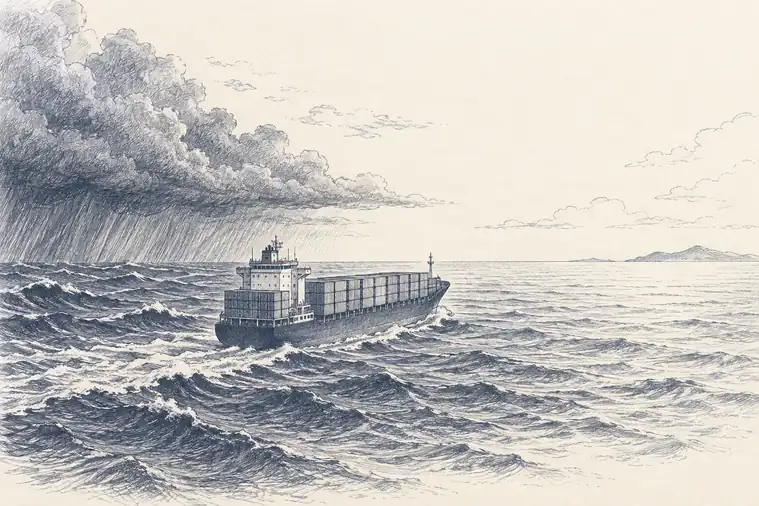
Air-traffic systems estimate where aircraft will be from flight plans, live surveillance, aircraft performance and wind forecasts. A jet stream can shift flight time and fuel burn enough to change the route before take-off. Maritime routing does the same with wind, waves, currents, vessel performance and port conditions. The forecast is not only where the ship will be. It is which route should be chosen, given several possible oceans.
Supply chains sit on top of both. A low river limits how deeply barges can be loaded, a storm closes a port, a flood removes a road, a heatwave slows trains and strains power. Physical forecasts become constraints inside logistics models, often crossing several organisations before anyone checks whether the uncertainty made the trip.
Usually it does not. A probability distribution enters the next system as a single expected value, because that is what the interface accepts, and the second model produces a precise-looking answer from an input that was never precise. This is where planetary forecasts acquire consequences, and where their doubt is most easily lost.
The engineered world and the natural one therefore meet at interfaces, and every interface is a small translation. Before any of these futures could be joined up, someone had to settle an earlier question: what the planet had actually been doing, everywhere, at every hour, including all the places nobody was watching.