DRISHTI · CHAPTER 3.8
The Planet We Reconstructed After It Happened
Reanalysis built a complete history of the atmosphere from records that were never complete, and then everyone tried to plug every other model into it.
EARTHVISION LAB · ~15 MIN READ
AN INCONSISTENT PAST
The record assembled so far has a flaw that makes it treacherous for studying change. The instruments kept improving. Stations opened and closed. Satellites launched, aged and were replaced.
A trend computed straight from the raw observations measures partly the climate and partly the history of the people measuring it.
Reanalysis is the response, and it is one of the odder ideas in Earth science. Take every historical observation, feed it through a single modern forecast model that is held fixed for the whole period, and let the model produce a physically consistent estimate of what the entire atmosphere was doing at every hour, including everywhere nobody was looking.
The result is the past as it would have been recorded if someone had been watching everywhere, all the time, with the same instruments. Nobody was. The reconstruction is nevertheless what most of modern climate science, and a surprising amount of artificial intelligence, now runs on.
DATA ASSIMILATION
How observations become a state
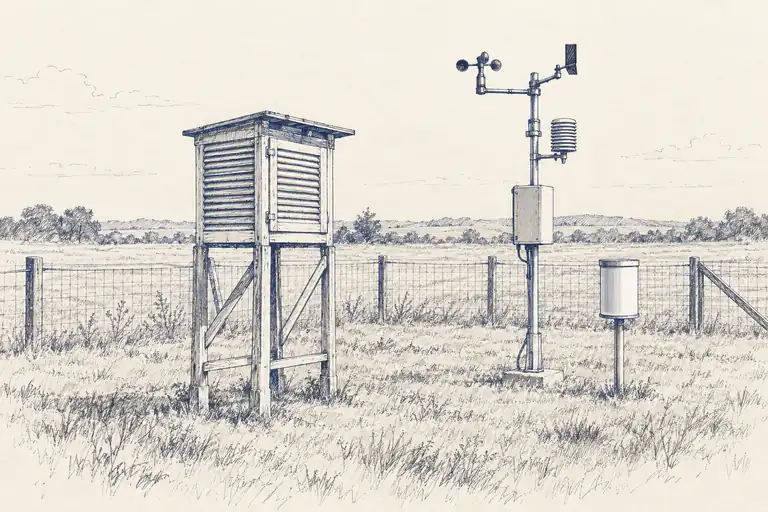
The machinery underneath is data assimilation, which is also how every operational weather forecast begins, and which deserves stating plainly because it is widely assumed to be simpler than it is. Observations do not become a forecast's starting state directly. They are combined with a short forecast from the previous cycle, each weighted by how wrong it is estimated to be, to produce a best estimate of the present that is consistent with both the physics and the measurements. It is also the cure for Richardson's problem: an assimilated state is balanced before the forecast starts.
This is necessary because observations are scattered, irregular and vastly outnumbered by the grid points a model needs filled. Over most of the ocean, at most hours, there is nothing at all. The model supplies the rest, constrained by physics, and the observations pull it towards reality wherever they exist.
Every gridded product made this way is therefore a hybrid: partly measurement, partly the model's opinion, in proportions that vary by place, altitude and decade, and that the product does not label. A value over the mid-Pacific in 1955 is mostly physics with a little data attached.
THE MODERN RECORD
What ERA5 actually is
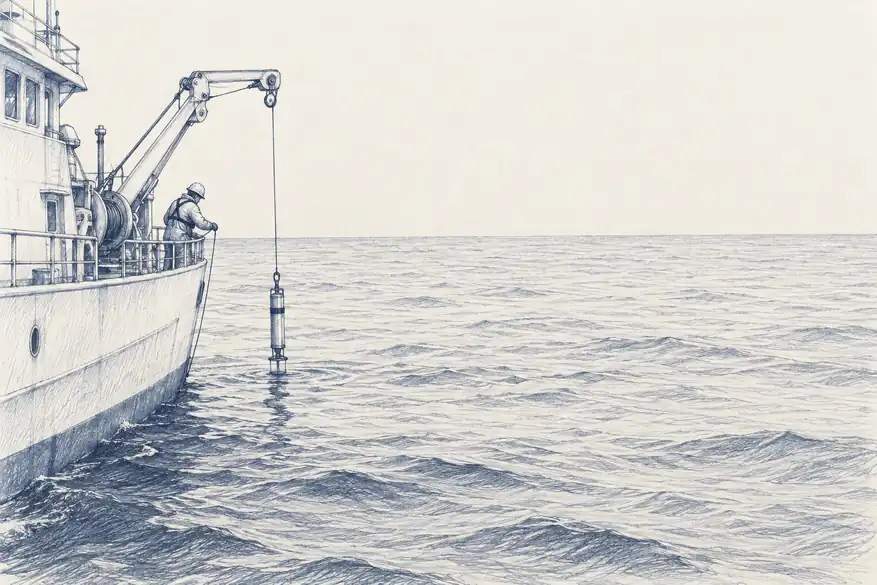
ERA5, produced by ECMWF, is the reanalysis most of this field now runs on. It provides hourly values of surface and upper-air variables on a global grid of roughly 31 kilometres, across 137 levels from the ground to about 80 kilometres up, from 1940 to the present, built by assimilating every available observation from the ground, the sea, balloons, aircraft and satellites.
The consistency is the product. Because one fixed version of the model processes the whole period, a trend computed from ERA5 is not contaminated by the model changing underneath it, even though the observations feeding it changed enormously between 1940 and now. What remains uneven is the evidence: recent decades, with satellites everywhere, are tightly constrained, while the 1950s are largely physics filling in around sparse measurements.
Reanalysis produces something with no clean precedent: a complete, gap-free, physically coherent account of a past that was never observed completely. It is not a measurement and not a simulation. It is the most probable past given the physics and whatever was written down, which is a legitimate and very useful thing to compute and a strange thing to treat as ground truth.
The field mostly does treat it as ground truth, because the alternative is worse and a consistent estimate is far more usable than an honest scatter of gaps. The cost is that a subtle error in the model becomes a subtle error in the historical record, and then in every model later trained on that record, with no observation anywhere in the chain to contradict it.
COUPLING
Can one model contain all of this?
Once the past had been reconstructed, the obvious next ambition was to model the whole planet forward in one piece. Modern Earth-system models already couple atmosphere, ocean, land surface, sea ice and ocean chemistry, each running its own equations while exchanging heat, water, momentum and carbon with the others, and it took decades to make that arrangement stable. The temptation is to keep adding: catchment hydrology, forest demography, crops, animals, power systems, freight, human decisions. The list becomes impressive shortly before the timestep becomes impossible.
Three mismatches survive any amount of computing. Time: the atmosphere needs steps of minutes, rivers hours, forests years, while markets move in seconds and planning in decades, so running everything on the fastest clock wastes enormous computation and running each on its own clock creates trouble at every boundary. Space: an atmospheric grid cell can be tens of kilometres wide while a flood barrier, field edge or power line is measured in metres, so everything has to be downscaled or averaged, and neither is free. Mathematics: conservation laws, crop relationships, network optimisation and policy scenarios describe physics, learned patterns and choices, and there is no common unit of uncertainty into which they all collapse politely.
The European Commission's Destination Earth programme shows how far physical coupling has reached. Its third phase began in June 2026 and runs to June 2028, with ECMWF, ESA and EUMETSAT continuing the Climate Change Adaptation and Weather-Induced Extremes digital twins and the shared Digital Twin Engine that runs them. The twins can run physically consistent what-if simulations at kilometre scale, and in selected regions finer, where more weather can be represented directly and local impacts become useful to decision-makers. Parameterisation does not disappear, and uncertainty does not become decorative.
What the twins do not yet contain, as tightly coupled parts, is most of the living and engineered world. Food markets do not exchange fluxes with cloud physics. Wildlife movement is not a routine state variable. Grid dispatch is not part of the atmospheric timestep. The planet remains more modular than the phrase digital twin suggests.
FEDERATION
One future probably needs many models
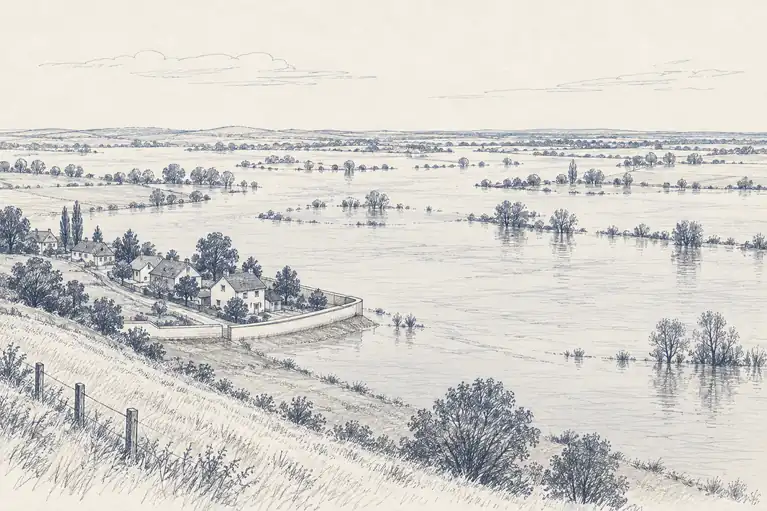
The more realistic arrangement is federation. Specialised models keep their own mathematics, scales and update cycles, and exchange state through explicit interfaces. A weather model drives a river model. The river model constrains a grid model or a logistics model. The outputs stay separate enough that their assumptions can still be inspected.
That solves the computing problem by refusing to create one universal timestep. It creates an information problem instead. Every interface has to decide what state to pass on, at what resolution, with what uncertainty attached, and for how long that state stays true.
Prediction therefore ends not with a single model but with a coordination problem. There are now many systems capable of producing useful futures, from a 1950 barotropic forecast's great-grandchildren to crop outlooks and grid schedules. What does not yet exist is a general way for all those futures to recognise that they refer to the same changing planet, and to notice when one of them changes what the others should expect.