DRISHTI · CHAPTER 3.5
Tomorrow Was a Homework Problem
Bjerknes set it in 1904, Richardson did it by hand and forecast a gale of nothing, ENIAC finally managed it, and Lorenz showed how far to trust the answer: not far, so run fifty futures.
EARTHVISION LAB · ~9 MIN READ
1904
In January 1904 Vilhelm Bjerknes published seven pages in Meteorologische Zeitschrift arguing that the weather was not a matter of proverbs, almanacs or an aching knee.
It was an initial-value problem in mathematical physics: describe the atmosphere as it is now, apply the laws it obeys, and the future follows by calculation.
He named seven quantities that together specify the state of the air at any point: pressure, temperature, density, water vapour and the three components of the wind. He took the equations linking them from fluid dynamics and thermodynamics rather than from meteorological tradition, which at the time consisted largely of drawing maps and remembering what had happened after similar maps.
Bjerknes knew perfectly well that nobody could measure those seven quantities through the full depth of the atmosphere, and that nobody could do the arithmetic if they did. The proposal said that tomorrow was not a mystery, merely a homework problem nobody had the time to finish. It took nearly half a century to find someone, or something, with the time.
1922
The man who tried to do it by hand
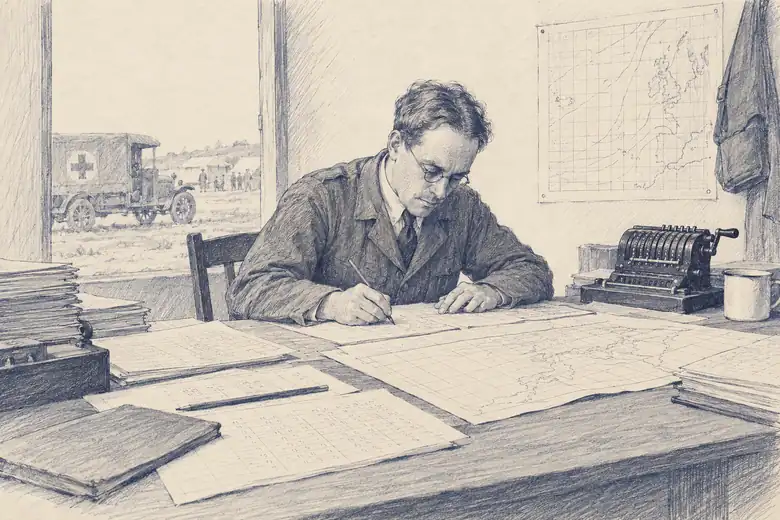
The Shape of a Doubt credited Lewis Fry Richardson with six weeks of arithmetic and a wrong answer. The more interesting part is why the answer was wrong. Richardson took Bjerknes literally. Working partly while he drove an ambulance on the Western Front, he divided the atmosphere into a grid of cells, stepped the equations forward in time, and in 1922 published the method as Weather Prediction by Numerical Process, complete with a six-hour forecast for central Europe calculated by hand from observations made on 20 May 1910.
The forecast said surface pressure would rise by 145 hectopascals in six hours. That is roughly the gap between ordinary sea-level pressure and the eye of the strongest typhoon ever measured, delivered over an unremarkable afternoon in central Europe. A reviewer noted that a wild guess would have done better. The arithmetic was fine. The trouble was in the starting data: small imbalances in the observed winds and pressures excited fast gravity waves, which exist in the equations, matter almost not at all to the weather, and drowned out everything that did.
Decades later the meteorologist Peter Lynch reran Richardson's calculation on a computer, first smoothing away those imbalances the way modern forecasts do. The method then produced a small, realistic pressure change, which is to say a perfectly sensible forecast. Richardson had been right all along. His observations had simply been rude to him.
Speed was the other difficulty. Six weeks of work for six hours of weather meant the method was not slow, it was historical. Richardson's answer was a fantasy: a great hall shaped like a globe, with 64,000 human computers seated at their parts of the map, each working the equations for one patch of sky, while a conductor in a central pulpit shone a light on anyone getting ahead of the others. It reads like whimsy. It is an accurate description of a parallel processor, written about two decades before anyone built a computer.
Perhaps some day in the dim future it will be possible to advance the computations faster than the weather advances and at a cost less than the saving to mankind due to the information gained. But that is a dream.Lewis Fry Richardson, Weather Prediction by Numerical Process, 1922
1950 AND AFTER
The first forecast that kept pace with the weather, and what it left out
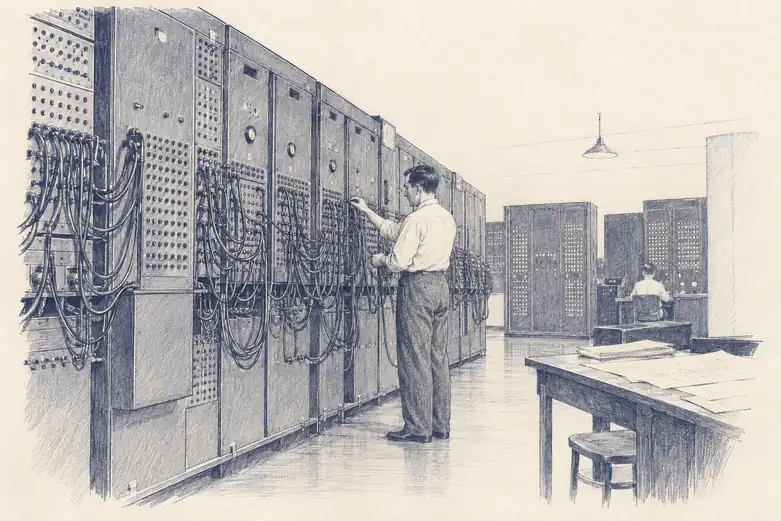
In April 1950 Jule Charney, Ragnar Fjørtoft and John von Neumann ran a forecast on ENIAC at the Aberdeen Proving Ground in Maryland. Their success came from doing less than Richardson, not more. Published as Numerical Integration of the Barotropic Vorticity Equation, their method ignored his full equations and used a simplified barotropic model that cannot produce the fast gravity waves at all. It kept only the slow, continent-sized Rossby waves that actually organise weather systems, and threw the troublemakers out before they could start.
They forecast a single quantity, the height of the 500-hectopascal pressure surface over North America, 24 hours ahead. Counting the punched cards, the machine took about 24 hours to do it. A forecast that arrives exactly when the weather does is operationally useless and scientifically epochal, and Charney noted that with routine operation the time could probably be halved.
Routine followed quickly. Sweden began issuing computer forecasts in December 1954 and the United States' Joint Numerical Weather Prediction Unit followed in May 1955. Within a few years the question was no longer whether a machine could forecast the weather but how much weather a forecast centre could afford to compute, and that question has been asked, with a slightly larger budget, every year since.
The usual telling makes this a story about computers arriving. That is half of it. The deeper discovery was that a more complete set of equations can produce a worse forecast than a deliberately incomplete one, because completeness admits things that are physically real, numerically unstable and irrelevant to the question being asked.
Every forecast model built since inherits that lesson. A forest model that simulated every leaf, a river model that resolved every pore of soil, a food model that tracked every household would each be more faithful and less useful. Choosing what to exclude is not a compromise in this field. It is the method.
The other inheritance is a ratio: the time a forecast takes to compute against how far ahead it reaches. ENIAC managed one to one. Every improvement since, in hardware, mathematics and eventually machine learning, can be read as an attack on that ratio, because a forecast that takes less time to make can be made more often, at finer detail, or many times over.
Bjerknes supplied the question, Richardson the method, ENIAC the speed and the barotropic model the discipline. None of them had yet asked how far a correct calculation could be trusted. That question arrived in the early 1960s, by way of a rounding error.
1961 AND CHAOS
A rounding error, and why deterministic does not mean predictable
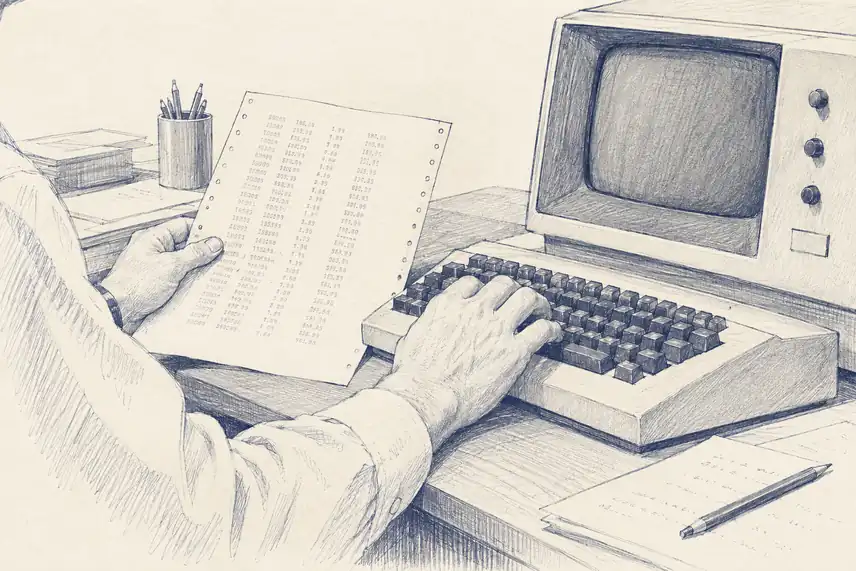
In 1961 Edward Lorenz, a meteorologist at MIT, wanted to look at part of a weather simulation again. To save time he restarted it halfway through, typing the numbers back in from a printout.
The printout showed three decimal places, 0.506, where the machine had kept six, 0.506127. He went for a coffee. When he came back, the new run had followed the old one for a while and then wandered off into an entirely different weather history.
Nothing random had been added. The equations were identical. The only difference was in the starting state, and it was smaller than any real observing network could ever hope to measure. Lorenz had run into the practical form of chaos: a system can obey its laws exactly and still become unpredictable, because tiny errors at the start grow until they are the whole answer.
Richardson's forecast had failed because its starting data were badly balanced. Lorenz's discovery was worse news. Even perfectly balanced data, unless they were also perfectly exact, would eventually fail too. The only open question was how soon.
Lorenz formalised the result in his 1963 paper Deterministic Nonperiodic Flow, and in 1972 gave it the title that escaped into popular culture: Predictability: Does the Flap of a Butterfly's Wings in Brazil Set Off a Tornado in Texas? The distinction he drew matters. If the exact present were known, the equations would return the same future every time. The difficulty is that the exact present is not knowable, and in a chaotic system the error does not stay politely small.
Weather therefore has a horizon for detailed prediction, usually put at around two weeks. Better observations and better models can push useful skill closer to it, but no amount of either can abolish the sensitivity that creates it. The atmosphere has agreed to be governed by physics. It has not agreed to be conveniently forecast.
This is why two forecasts started from almost identical analyses can eventually disagree about where a storm will make landfall. The disagreement is not automatically evidence that one model is broken. It may be evidence that the present genuinely supports several futures, all of them physically reasonable, and that nobody yet knows which one the atmosphere has chosen.
ENSEMBLE PREDICTION
Run a family of plausible presents
The answer, once computers were fast enough to afford it, was to stop running one forecast. In December 1992 both ECMWF in Europe and the U.S. National Meteorological Center began issuing operational ensemble forecasts: many runs from slightly different versions of the present, each nudged within the range of what the observations could not rule out, and in some systems with the model's own physics nudged as well. ECMWF's ensemble now runs 51 members every cycle, one from the best estimate of the present and fifty from its plausible neighbours.
The spread among the members is information. A tight bundle says the current situation is well constrained. A bundle that fans out quickly says small uncertainties matter today and confidence should fall. Probabilities are then built from the members, with statistical calibration, rather than by pretending that any one member is the future.
The difference matters to anyone who has to act. A cyclone track with a narrow envelope of possible paths and one with a wide envelope may share the same most-likely line on a map, and demand completely different decisions about which towns to evacuate and which reserves to ready. The line is easy to draw. The envelope around it is the forecast.
THE LARGER LESSON
Uncertainty is part of the state
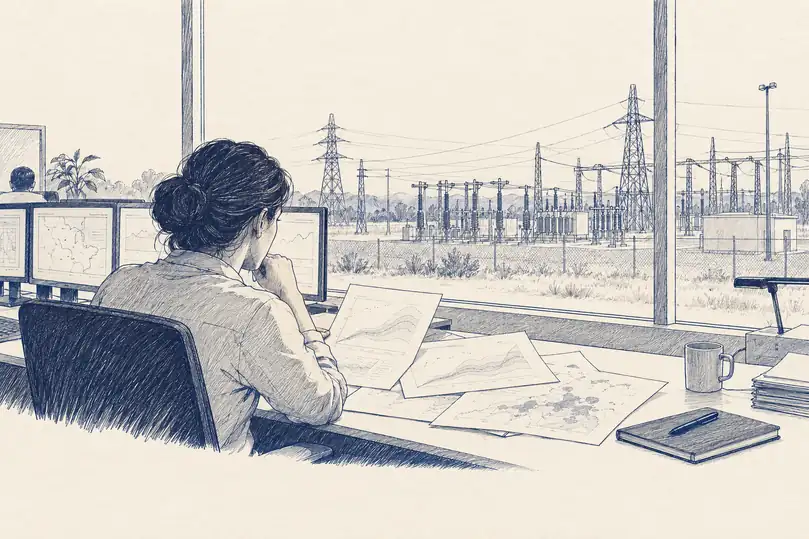
The same logic now runs wherever a forecast depends on an uncertain present, uncertain parameters or several plausible scenarios. River forecasters run ensembles of rainfall and catchment states. Grid operators work with probability distributions for tomorrow's wind and solar output. Crop and ecological projections run ensembles across weather, management and competing model assumptions.
The change is conceptual. A forecast is not a value about the future. It is a distribution over futures, conditioned on an imperfect present. Once that is accepted, uncertainty stops being an embarrassing footnote and becomes one of the main things the system produces.
Progress since has been quiet and remarkably steady. Medium-range forecast skill has improved by about a day per decade, so that a six-day forecast is now roughly as good as a five-day forecast was ten years earlier. None of that progress removed the spread. It made the spread narrower, and more honest about what it contained.